Rock Outcrops Along Buffalo Bayou
This site provides interactive visualizations of geologic field data collected along Buffalo Bayou in Houston, Texas. While there are many geologists in Houston, there are few rock outcrops. This website details some of Houston's limited rock outcrops that appear during low water levels along Buffalo Bayou.
📄 This website visualizes the data archive of a publication
The outcrop photos, thin-sections, and other data visualized on this website were collected or created by the authors of the publication:
Patterson, P., Kendall, J., Schwartz, A., Novello, J., Gaston, W., Lang, R., West, D., Gosses, J., & Wachtman, C. (2025).
Sedimentology, Sequence Stratigraphy, Diagenesis, and Paleogeographic Reconstruction of the Beaumont Formation,
Late Pleistocene, Buffalo Bayou, Houston, Texas. Houston Geological Society Bulletin, June 2025.
[PDF]
Please refer to this website's GitHub repository's README.md for information on how to download or work with this data.
Choose a View
🗺️ Large Map View
A single large interactive map showing all data layers. Click on icons to see outcrop images, bedding plane strike/dip measurements, and field notes as pop-ups.
Open Large Map →🔗 Four Linked Maps
Four synchronized maps (topo, geologic, street) that pan and zoom together. Click anywhere to see the location across all maps and get geologic unit info from Macrostrat.
Open Four Maps →📷 Photo Gallery
A scrollable gallery of all outcrop photos with descriptions and mini location maps. Great for viewing photo details without needing to click through map popups.
Open Gallery →📊 Well Cross Sections
Regional dip and strike cross sections plus individual well log data from 14 well locations across the Buffalo Bayou area. View detailed subsurface correlations.
Open Cross Sections →🔬 Thin Sections
Petrographic thin section analysis from Buffalo Bayou outcrop samples. View mineral composition, texture, and fabric under polarized light microscopy.
Open Thin Sections →About the Data
This repository serves as both a visualization tool and a data archive for geologic observations along Buffalo Bayou collected by the Houston Geological Society working group.
Data includes:
- Outcrop photos with location coordinates
- Bedding plane strike and dip measurements
- Lineament mapping from field observations and LIDAR
- Regional fault traces (from subsurface seismic)
- Nearby well locations
Note: Regional fault traces shown are mapped from subsurface seismic and are mostly not exposed at the surface. Their geographic positions should be considered approximate.
How to use data:Please refer to the GitHub repository's README.md for information on how to download or work with the data shown on this website.
Data Sources & Credits
Geologic Field Data:
- Photos, strike dips, and other field observations collected using the Midland Valley Clino app by Jerry Kendall and the HGS Buffalo Bayou working group.
- Richard Lang created the well log cross-sections. Well log data was collected by Dorene B. West and Richard Lang. Well logs were sourced from [Texas Commission on Environmental Quality](https://www.tceq.texas.gov/gis/waterwellview.html).
Base Maps:
- Macrostrat - Geologic map tiles and API. Citation: Peters, S.E., Husson, J.M., & Czaplewski, J. (2018). Macrostrat: A Platform for Geological Data Integration and Deep-Time Earth Crust Research. Geochemistry, Geophysics, Geosystems, 19(4), 1393-1409.
- OpenStreetMap
- OpenTopoMap - Topographic maps from OpenStreetMap and SRTM data (CC-BY-SA 3.0)
- ESRI World Imagery and National Geographic World Map
- Google Street View for street-level imagery
📊 Current Water Level - Buffalo Bayou at Houston (USGS Gage 08074000)
Check the current gage height before planning a field visit. Most outcrop photos were taken when the water level was between 1-2 feet. Higher water levels will submerge the outcrops.
Data provided by U.S. Geological Survey. Gage operated in cooperation with Harris County Flood Control District.
Field trip safety
Although outcrops along Buffalo Bayou may be of interest to the many geologists in Houston due to the scarcity of outcrops along the Texas coastal plain, please remember that these locations are only visible at low water levels and can be dangerous to access. Always prioritize safety, be aware of weather conditions, and obtain any necessary permissions before visiting field sites. Many of these sites require a kayak or canoe to access which requires proper safety equipment and experience. Access by foot is often not posssible and when possible involves traversing slippery slopes next to water, which would require use of a PFD and may be too much of an atheltic challenge for some individuals. Most photos were taken when the USGS guage at Shepard street was slightly above 1 foot.
Closely Related Resources Elsewhere (digital elevation models)
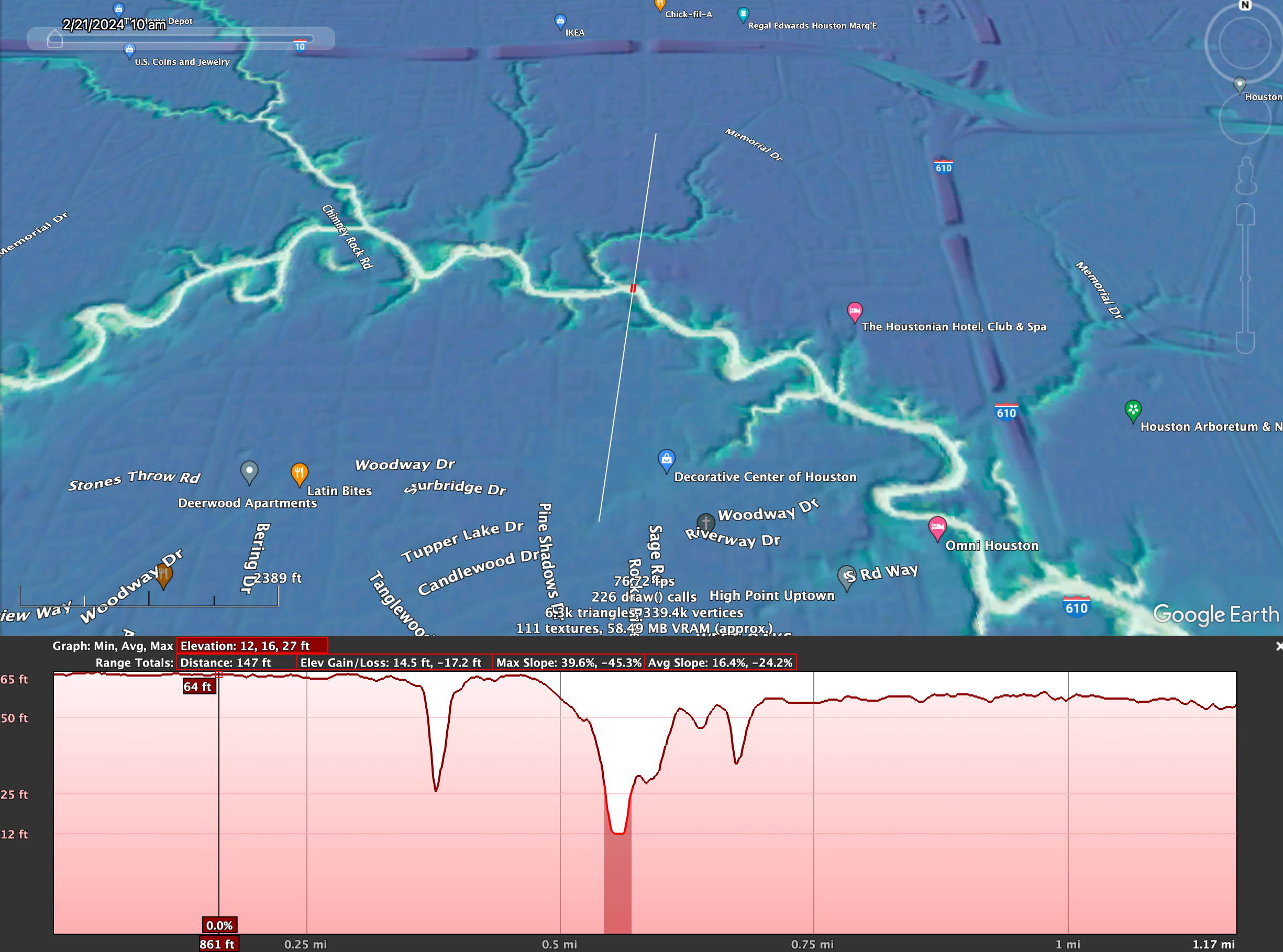
Somewhat separate from the question of the depositional environment of the bedrock exposed in outcrops along Buffalo Bayou is the question of why Buffalo Bayou exists where it is and flows east not south towards the coast. Although the information in the bedrock exposed in Buffalo Bayou can help a little with that question, much of the answer can be found in the topography and surficial geology of the region.
Originally, this repository held some Python code for analyzing digital elevation models of the Houston area and creating Relative Elevation Maps (REM) that make small changes in topography more visible. That work has since moved to a separate GitHub repository: buffalo_bayou_geology_REM
It forms the basis of the blog post: "Houston has topography: Looking at why Buffalo Bayou does not drain to the sea, directly" and may be of interest for answering the question of why Buffalo Bayou flows where it does and how it differs from some of the larger regional fluvial systems.